AI Success Starts Long Before You Choose the Right Tool
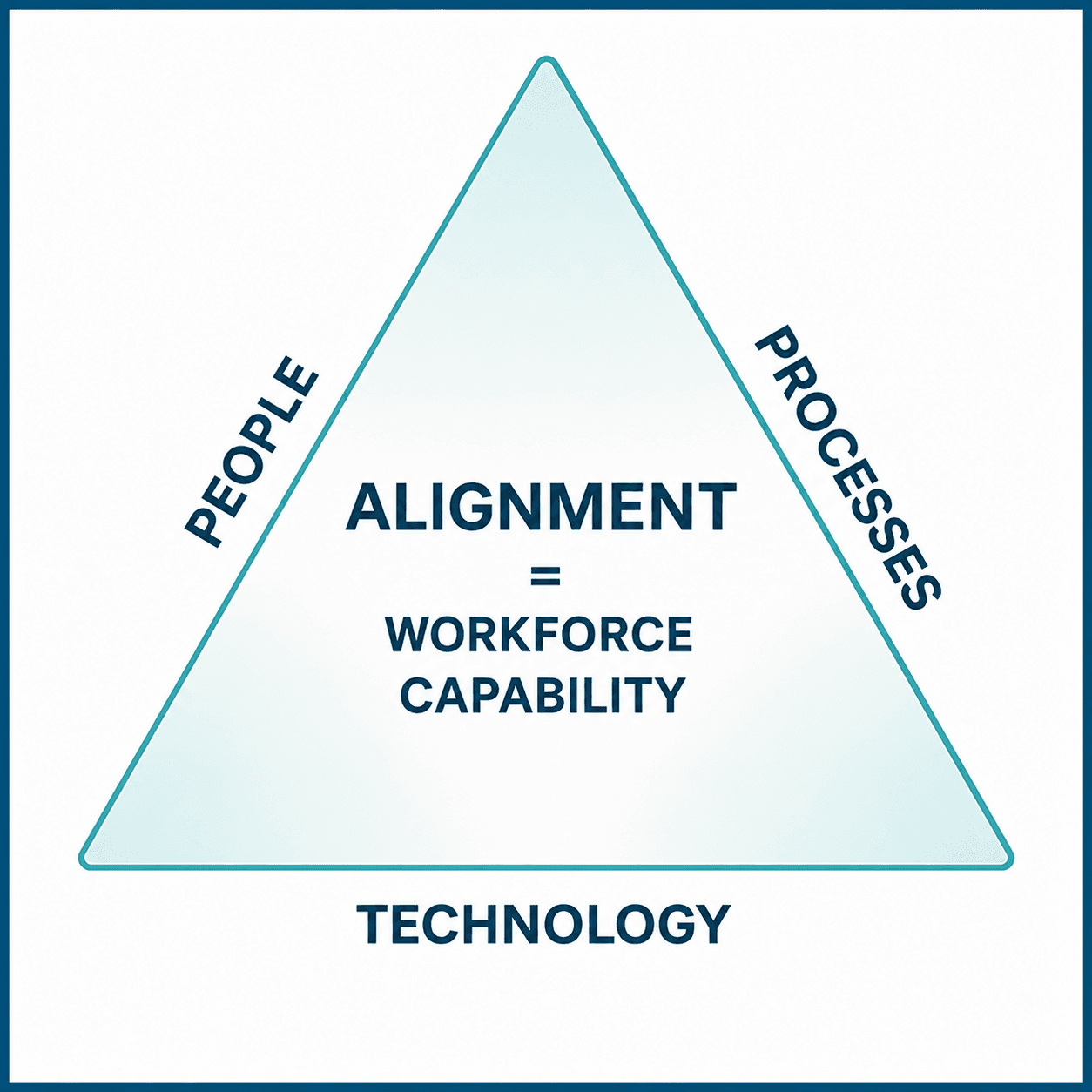
People + Processes + Technology in Alignment = Workforce Capability

Using the Right Words
So … you’re using an AI-powered conversational product (let’s call it a tool) and you’ve come a long way. Maybe you started conversing with it a few years ago, or only months ago, but it has become your go-to for everything: generating content, brainstorming, researching, analyzing, reframing, interpreting, tightening, and illustrating.
Congratulations! You’ve taken the first step. But that’s not “learning AI.” You began to use one AI-powered tool among hundreds (and likely thousands) of tools hitting the market every year. Learning AI is so much more than that.
The Basics: AI Is a Technology Layer
Artificial Intelligence (which I prefer to call Augmented Intelligence) refers to systems and software that simulate aspects of human intelligence, such as learning, decision-making, and adapting based on data. In a workplace context, this means integrating tools that can automate decision processes, understand natural language, recognize patterns, or make predictions.
Let’s compare yesterday to today:
Traditional software applications (apps, programs, platforms) follow fixed rules provided by programmers and do not learn or adapt.
By contrast, AI-powered tools and platforms are designed to learn from experience and adapt over time. Often, they also handle complex, variable tasks rather than just execute instructions.
Integrating AI into the Workplace
Think about the last time you experienced a learning curve with a new software application at work. Was it the app itself that changed things—or the way your team and processes adapted around it? The answer is everything needed to change. The same is true with AI.
To be successful in business, you need people and processes to be well-aligned with the layers of technology you integrate into that environment. When those three elements are aligned through effective planning and applied training, AI becomes a catalyst for clarity, speed, and better-informed decisions.
People + Processes + Technology in Alignment = Workforce Capability
What if people, processes, and technology are misaligned? There’s a LOT of that happening right now.
If you cram disruptive technology into a workplace without a plan or proper training—or you do nothing while it seeps and creeps into workflows because your most tech-savvy employees won’t wait for you to upgrade five years from now—that’s an implosion waiting to happen.
It’s like stretching a rubber elastic band beyond its tensile strength. It eventually snaps. You snap. Everybody snap-snap. And the system or project fails. Not because of the technology itself, but because the processes and people aren’t in sync with it.
First, the process is likely outdated if it wasn’t modified to include and enable the incoming technology. Next, the people risk becoming frustrated, overwhelmed, and divided when “it doesn’t work” or “it’s too much.”
Before organizations can effectively build AI capability, they first need to understand where they stand. Which teams are ready to adopt new technologies? Where do skills gaps exist? Which processes are creating friction rather than enabling progress?
Rather than relying on assumptions, evidence-based workforce assessments can provide leaders with the clarity needed to prioritize development efforts, align people, processes, and technology, and build capability with confidence.
Let’s Break That Down
“It doesn’t work.” I once observed a smart, multi-talented but proudly traditional team nitpick a new tool because it couldn’t exactly replicate their manual steps or time-honoured formats. They also wanted to “test it” themselves, pushing tech-savvy colleagues from another team to the sidelines. What could have saved 100+ hours of repetitive work (the tool’s purpose) instead led to 200+ hours of pushback discussions, project delays, and heated frustrations (because of the tool’s “limitations”). There’s a lot to unpack here but suffice to say the tool never stood a chance to demonstrate its full potential.
“It’s too much.” This usually signals resistance to the learning curve, not the tool itself. I’ve seen people cross their arms and shut down during a demo, overwhelmed by features and doubtful of benefits. This is where professor-style lecturing to “show them what it can do” isn’t enough (and that’s not real training, by the way). What bite-size, hands-on, real-world exercises can you help them master in skills-building increments? In situations like these, technical complexity isn’t the roadblock. It’s insufficient planning, communication, and learning-by-doing training. Without those, even simple steps feel impossible.
We Forget Sometimes
If AI is a bit scary to you, this won’t be the first or last time you’ll be challenged to change or be changed. Whether you lived it or learned about it later, think back to massive technological shifts in recent decades that directly impacted people and processes:
Remember when email was still called “electronic mail” and we spelled it “e-mail”?
… when sending a text message meant pressing a button four times just to type the letter “S”?
… when many (who now deny this) dismissed social media as a fad?
… when SEO clamped down on “keyword stuffing” and other lazy hacks by blasting out new algorithms to counter bad content?
… or when remote work seemed impossible, until it became mainstream?
AI isn’t the first massive shift in our lifetime, but it might be the fastest. Put simply, “learning AI” is about acknowledging the transformation we’re experiencing now and accepting disruption as part of the journey.
It’s about noticing how and why people, processes, and technology adapt at different speeds, and recognizing options to align them with purpose.
It’s also about embracing the bold curiosity to explore new and better ways of being productive, innovative, efficient, and resilient no matter what your role is at work.
Enter the “Democratization” of AI
This is the exciting part! AI has the capacity to augment almost everything we do as humans. What’s remarkable is that it’s more accessible to everyday people than ever before—through prompts and natural language, affordable platforms that scale easily, and tools already in our hands.
That’s the “democratization of AI*”: opening access beyond specialists so that anyone can compete on a more level playing field. Not just giant corporations worth billions of dollars. The gates have crashed down to let in solopreneurs, entrepreneurs, small businesses, leadership teams, and employees across the company … everyone.
Democratization is why “learning AI” goes far beyond mastering one product. There’s a broader shift where accessibility itself has become the new frontier.
*Note: The phrase “democratization of AI” isn’t mine. It emerged organically within the technology community as AI became more accessible to the public and organizations. Key enterprise players like Microsoft have promoted the idea since at least the mid-2010s, stating goals to “democratize Artificial Intelligence (AI), to take it from the ivory towers and make it accessible to all.” My article focuses on practical user access perspectives, but “democratization” can extend to governance and ethical implications as well.
The Challenge … or the Opportunity?
Once specialized and costly, AI is now mainstream, accessible, and within reach for organizations of every size. Rather than focusing on mastering another tool, the better opportunity is to build a workplace where people, processes, and technology evolve together.
If you’re an employer, you need to align people, processes, and technology to avoid chaos and fragmentation. Do nothing and chaos and fragmentation will happen anyway.
And that, dear readers, is the essence of “learning AI.” How willing are you to learn, unlearn, and relearn what used to work well, so you can work better?
AI-powered systems are purpose-built to learn and adapt. So are you. Are you ready to augment YOUR potential?
About the Author:
Andrée Paige, Strategic Communications Advisor, Ottawa Education Group
With over two decades of leadership in strategic communications, integrated marketing, and corporate storytelling, Andrée Paige has guided executive teams through major transformation and growth. Known for her clarity, creativity, and purpose-driven approach, she helps organizations communicate with impact. At OEG, Andrée provides communications and content strategies, media relations, campaign direction, and brand impact leadership to amplify our company’s voice and visibility.